.svg)


 Apr 06, 2026
Every few months, the income hit. Then silence.
That's the reality of the course launch cycle. You build, you promote, you sell, and then you start over. Mike Indovina lived it for three years running Master Your Mix, his online education business for rock musicians learning to record from home. The courses worked. Students got results. But the income was unpredictable and exhausting to sustain.
"Feast or famine" isn't just a phrase. It's a business model that wears you down.
When Mike heard someone talking about memberships creating recurring, compounding revenue, something shifted.
What followed wasn't an overnight transformation. It was a messy, iterative journey that ended with a $197/month coaching membership model where members stay for years. Some stay without ever releasing a song.
This is what the "courses vs. memberships" debate looks like when it's actually lived.
What Is the Difference Between an Online Course and a Membership Site?
An online course is a one-time purchase that delivers a fixed curriculum. Members pay once, consume the content, and the transaction ends. A membership site is an ongoing relationship where members pay monthly or annually for continued access to content, community, coaching, or some combination.
The business difference is significant. With a course, every month starts at zero. With a membership, you carry revenue forward. Subscription businesses grow 4.6x faster than S&P 500 companies for exactly this reason: the revenue compounds instead of starting from zero every month.
Mike's course sales weren't bad. His very first customer, a man named Paul Austin from the UK, is still a student years later. But four sales on a launch after months of preparation is a rough return on effort. The model itself was the problem, not the product.
How Did Mike Indovina Build an Audience From Scratch?
Before the courses, before the membership, there was a cheat sheet.
Mike started as a drummer. His bands had real momentum: radio play, TV appearances, touring. But musicians' priorities shift as life changes, and after watching his bands dissolve one by one, a roommate who ran a guitar instruction site suggested a different path: teach recording online.
He created a mixing cheat sheet as a lead magnet and needed a way to get it in front of people. His approach was scrappy and smart. He paid Instagram accounts in his niche between $20 and $50 to post his freebie. The leads came in at seven cents each. He was on vacation with his wife when his phone started blowing up with new subscribers.
That strategy, sometimes called borrowed influence, let him build an email list without an existing audience. He later applied the same principle to his podcast, Master Your Mix, which now pulls in 15,000 downloads a month. He interviews well-known engineers and producers, and their audiences discover him in the process.
By the time he considered launching a membership, he had roughly 6,000 people on his email list.
Is a Membership Better Than a Course for Creators?
It depends entirely on what you're trying to build. For creators who want predictable income and deeper relationships with the people they serve, the membership model has a structural advantage.
Courses front-load all the revenue. You make money during launch windows and then wait for the next one. Memberships spread revenue across months and years. A 5% increase in retention can boost profits 25-95%, and in a membership, retention is the whole game.
Mike didn't abandon courses entirely. They became a different tool in his business, often a starting point for new students before they move into his coaching membership.
That layered approach, where courses and memberships serve different stages of the customer journey, is more common than the either/or framing suggests. You can see how other creators have structured similar approaches in these membership site examples across every niche.
What Is a Founding Member Launch?
A founding member launch is a small, intentional first cohort of members, typically offered at a special rate before the membership is fully built. The goal isn't scale. It's validation.
When Mike made the leap, he emailed his 6,000-person list. He got 12 members.
That number sounds underwhelming. It wasn't. Twelve people paying proved the idea worked. He started that first membership at $12.99 a month and ran it for about three years. The structure was simple: two videos a month, a group Q&A call, and a public mix review where Mike gave feedback on member recordings.
The founding member launch removes the trap most creators fall into: building for months before knowing if anyone will pay. You sell first, build alongside your members, and let the feedback shape the product in real time. It's the same logic Krystal Schouten used when she launched The Body Reset Method with past clients before her content library was finished.
Starting small isn't a failure of ambition. It's how you grow beyond your founding members without building something nobody wanted.
What Does Mike's Membership Actually Look Like Now?
After running that first membership for three years, Mike closed it and rebuilt. The rebuild wasn't driven by failure. It was driven by clarity.
He noticed that the part he loved most was the feedback: listening to someone's mix and telling them exactly what to improve. So he built a membership around that.
The current offer is $197 a month. Members get one-on-one chat access, Loom video feedback on their mixes, access to the full content library, monthly group calls, and challenges. It's structured around the CCR model: Content, Community, and Coaching working together.
Mike also runs a $5,000 high-tier program with weekly one-on-one calls where he and the student mix sessions together. The membership sits below that as a natural downsell, and it serves as a continuation point for people who complete the higher-tier program but want to stay connected. One membership feeds both directions.
His daily workload for the membership: about one hour.
That's not a claim about passive income. He's actively doing reviews, answering questions, and showing up for monthly calls. But one focused hour a day is a very different life than sprint-and-crash course launches.
Why Do Members Stay for Years Without Releasing Music?
This is the part that surprises people, and it's also the part that matters most for understanding membership retention.
Mike has members who stay for years without releasing a single song. By surface-level metrics, they're not making progress toward the stated goal of recording professionally. But they're not leaving. When you dig into why, the answer reframes what a membership is actually selling.
One member is a veteran with PTSD and depression. His wife emailed Mike to say that the membership brings her husband joy. He releases maybe one song a year, but he logs in, participates, and feels like he belongs to something. The music and the community are his outlet.
Two fans once told Mike that music from his band had helped them choose to stay alive during dark moments.
These stories aren't anomalies. They point to something real: community and relationships drive retention more than content ever will. Members who feel connected to each other and to the creator stay long after they've consumed everything in the library. Content gets them in the door. Connection keeps them.
This is why the "what content do I need to create?" question, while important, is often the wrong first question. The better question is: what kind of environment do you want to build?
How Do You Turn a Hobby Into a Membership Business?
Mike's biggest internal battle wasn't technical. It was this: who am I to charge for this?
He describes it as a fear of success. Overthinking whether the content was good enough, whether the tech was set up right, whether the audience was big enough. "Easy for you" doesn't mean "not valuable for them," and that distinction is one most creators struggle to internalize.
A few things worth pulling from his experience:
-
Short videos can be more valuable than long ones. Five minutes of precise, actionable feedback outperforms a 30-minute lecture if it solves the right problem.
-
You don't need a business background. Mike came from music. His expertise was recording and mixing. The business part was learned as he went.
-
An application process filters for the right members. Mike uses one to make sure the people who join his coaching membership are serious and a good fit. This protects both the member and the community.
-
And you don't need a massive list. 6,000 people produced 12 founding members. That's not a bad ratio for a first launch to a cold offer.
If you want to keep new members engaged from day one, the mechanics matter less than whether members feel oriented and welcomed immediately. That's where most memberships lose people in the first 30 days.
What Should You Do If You're Stuck Between Courses and Memberships?
The honest answer: you don't have to choose permanently.
Mike ran courses for years. They built his list, validated his teaching, and connected him with students like Paul Austin who became long-term fans. The courses weren't wrong. They just weren't the full picture of what the business could be.
The membership didn't replace the course business. It extended it. Students enter at different price points, some through the content library, some through the high-ticket program, some through the coaching membership. Each serves a different stage of where someone is in their journey.
What the membership changed was the baseline. Instead of starting each month at zero, Mike carries revenue forward. Instead of chasing new customers constantly, he builds relationships that compound over time. Instead of racing to fill launch windows, he wakes up knowing roughly what next month looks like.
That's the real difference between courses and memberships. Not better or worse. Different jobs, different outcomes. But if the feast-or-famine cycle is wearing you down, the math of recurring revenue is hard to argue with.
Ready to start your own membership? The right place to begin is simpler than you think. Pick the problem you solve best, find 10 to 20 people who have that problem, and make them an offer before you build anything else. Let the founding members tell you what to build next.
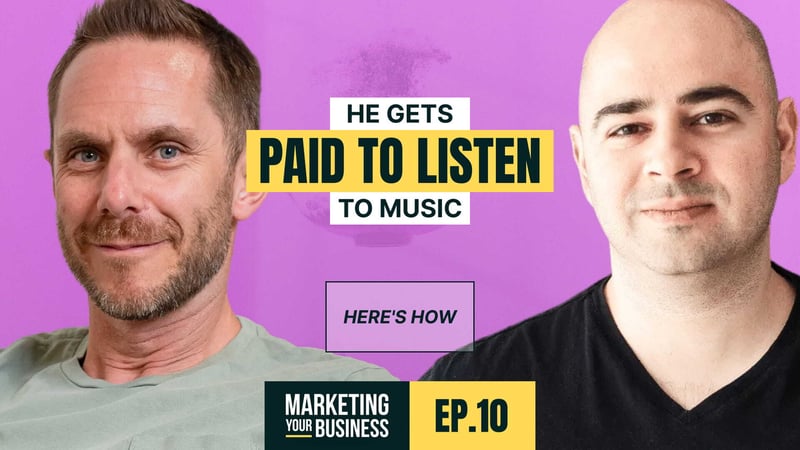
Mike Indovina started with a mixing cheat sheet and 7-cent leads. Now he spends an hour a day listening to music and telling people how to make it better.
"I just love listening to music. So now I get to do it all day and get paid for it."
That's the point.
Want more marketing and membership tips? Subscribe to Stu McLaren's Marketing Your Business podcast!