.svg)


 Mar 30, 2026
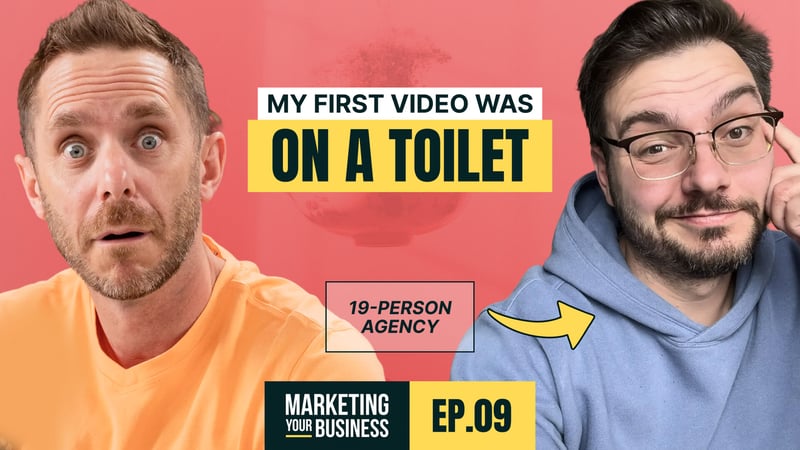
On a recent episode of the Marketing Your Business podcast, Stu McLaren sat down with Matt Diamante, founder of Hey Tony, an SEO agency that's gone from 3 employees to 19 in just three years.
The conversation was packed with practical stuff: How to make boring topics go viral. Why Google doesn't care if AI wrote your content. How Matt stumbled into selling courses and memberships. And the founding member launch that brought in 300 paying members for something that didn't exist yet.
This is a must-watch for anyone growing their audience!
Making SEO go viral (yes, really)
Matt's first Instagram videos were dry. Textbook SEO tips, no frills. "Here's an internal link. It helps you do this." The kind of content that's accurate but easy to scroll past.
Then something clicked. A video went viral and Matt started reverse-engineering what worked.
The formula he landed on: pair an absurd visual hook with a genuine SEO tip. Film yourself under a table at a conference while explaining keyword research. Pivot from wedding advice to backlinks at your cousin's reception. Sit on a statue of two rabbit-headed humans riding a bike in Amsterdam and talk about Google rankings.
"I have to trick people into learning about SEO," Matt said. "If I just gave that tip, they're not stopping to watch. They're not even going to get to the point of hearing it."
The visual hook stops the scroll. The audio hook pulls people in. And then ... they're learning something useful before they realize what happened. If you're trying to drive membership sign-ups through social media, this approach is worth studying.
The content rules Matt follows
A few things that came up repeatedly in the conversation:
Never acknowledge the visual hook. If you're going down a waterslide, don't mention the waterslide. The disconnect between what people see and what they hear is what keeps them watching.
Keep 3-4 transition phrases ready. Matt uses lines like "Oh, I was just thinking about..." to bridge from the absurd setup into the actual tip. Keep it simple. Don't overthink it.
Tighten everything. Stu would push Matt to do a second take and cut the length in half. Cut the dead space, the "ums," the pauses. For Matt's style, tight and fast works.
Take more swings. This was Matt's number one recommendation. Post every single day. Post three times a day. Keep trying different things until something works, then do more of that.
"That's literally the formula for everything in marketing," Matt said. "You have a campaign that's doing really well. You're not going to start from scratch next time. You're going to do more of that."
For anyone building a content strategy that converts, this is the mindset shift. Volume first. Refine later.
AI and SEO: the myth that needs to die
This was the part of the conversation that might surprise people the most.
Stu asked point-blank: will Google penalize you if the content on your site is AI-written?
Matt's answer: "Google does not care who wrote the content. AI, human ... they don't care. As long as the content is helpful and it is solving a problem for the user."
He's been using ChatGPT to produce client content for years. His client results keep going up. The catch? You can't publish AI slop. Pumping out 300 low-effort articles a month with zero oversight will get you nowhere. But using AI to do 80% of the heavy lifting on well-researched, genuinely helpful content? That works.
Matt shared his go-to prompt: "I want to answer this question. Ask me any questions you'd need to know the answer to in order to write a truly helpful, unique blog post that showcases my expertise, experience, case studies, and opinions."
Then he answers ChatGPT's follow-up questions using voice on his phone and gets a blog post back in five to ten minutes. Built on real expertise, real examples. And it ranks.
His recommendation: one to two articles per week.
Even his highest-paying clients only get two posts weekly. Build content around questions your audience actually asks. Tools like Answer the Public can surface those if you're stuck. If you're exploring how to use AI tools like ChatGPT in your membership, Matt's workflow is a solid template.
ChatGPT search isn't replacing Google (yet)
Matt pushed back on the narrative that ChatGPT is eating Google's lunch. "People will still type in 'best restaurants near me' on Google. It's additive at this point."
His agency tracks traffic from ChatGPT, Perplexity, and other LLMs through Looker Studio reports. Clients who rank well on Google are also getting recommended by AI platforms. The two aren't competing ... they're compounding.
"All you need to do is write good, helpful content and rank on Google," Matt said. "These platforms will also recommend you because they're looking at the same signals."
From accidental course creator to membership owner
Matt didn't set out to sell courses. He built an internal SOP for his agency ... a step-by-step guide to SEO that new hires could go through. His team members came out of it a few days later ready to work.
Then he wondered: if it trains my team, could I sell it?
He tried. Made $10,000 from a tiny email list. So he kept going.
"I can't help everybody," Matt explained. "Not everybody has $3,000 or $5,000 a month to pay an agency. I want to help the little guy down the street who has the time and drive to do this themselves."
That's why his products are priced in the hundreds, not thousands. His SEO tools start at $10 a month. The next cheapest competitor charges $70-100.
His first community attempt was $250 per month with ten members. He shut it down because he couldn't deliver enough value at that price with his schedule. He kept iterating until he found a format that worked: guided SEO implementation calls where members actually do the work during the session. Show up for an hour, walk away with a published piece of content. If you're thinking about how to find new members for your membership, Matt's journey is encouraging.
The founding member launch that changed everything
Here's where the story gets wild. Matt heard Stu talk about founding member launches and thought it sounded crazy. "I'm gonna launch a membership with no idea. Here's a payment link. There's nothing. We're gonna figure it out together."
He told people: "If you join this, you get to be my boss for a little bit. Boss me around, and I'm going to make whatever you want."
Around 300 people expressed interest. Many of them paid $27 per month. Matt went from zero to $3,000-4,000 per month in recurring revenue without having a single piece of membership content ready.
"I was freaking out," he admitted. "I threw my full course in there and said, start with this. We're gonna figure out everything after."
He's since rebuilt the experience on Membership.io, structuring content into levels based on where each member is. Level one is for people who don't even have a website yet ... three or four videos, twelve minutes total. Members level up as they progress and earn achievements along the way. That personalized experience is one of the most effective membership retention strategies you can use.
If a founding member launch sounds wild, Matt is living proof it works. You don't need everything built. You need an audience that trusts you and a willingness to figure it out together.
The origin of "Hey Tony"
One last thing. Matt's name is Matt. His company is called Hey Tony. Here's why.
Walking to lunch in downtown Toronto, he overheard a construction worker say to another: "Hey Tony, you always know how to put a smile on my face."
"What a genuine expression of emotion from somebody you would not expect," Matt said. "That's the kind of feeling I want my business to have with everybody."
You can follow Matt and the Hey Tony team on Instagram or visit heytony.ca to learn more about his SEO agency, courses, and membership.
What to take away from this
If you're building a membership or thinking about launching one, Matt's story has a few lessons worth absorbing:
- Daily content compounds. Matt posted every single day for three years. That's what grew his agency from 3 to 19 people and built the audience that funds his courses and membership.
- You don't need perfect to start. His first video was filmed sitting on a toilet. His membership launched with nothing built. Both decisions changed his business.
- AI is a tool, not a shortcut. Use it to speed up content production, but feed it your real expertise, real examples, and real opinions. That's what makes the content rank.
- Personalize the member experience. Not every member is at the same level. Meeting people where they are ... and giving them a clear, short path forward ... keeps them engaged.
- Consistency beats everything. "Everybody who quits, you're going to be ahead of them," Matt said. That's the whole game.
Whether you're working to build a community that markets itself or shaping your membership marketing strategy, the formula is the same: show up, help people, keep going.
Want more marketing and membership tips? Subscribe to Stu McLaren's Marketing Your Business podcast!